

Education lessons with Beyond Horizon VR.
Year 3, 5, & 7
Atoms & Molecules: The Particle Model of Matter
Delve down deep - beyond microscopic - to observe the particle model of matter and how it can be used to describe the behaviour of substances.
Curricular Connections:
Australian Curriculum v9 codes covered: AC9S3U04, AC9S5U04, AC9S7U05
AC9S3U04 – Year 3 Science: Investigate the observable properties of solids and liquids and how adding or removing heat energy leads to a change of state.
AC9S5U04 – Year 5 Science: Explain observable properties of solids, liquids and gases by modelling the motion and arrangement of particles.
AC9S7U05 – Year 7 Science: Use particle theory to describe the arrangement of particles in a substance, including the motion of and attraction between particles, and relate this to the properties of the substance.


Skills
Scientific Inquiry, Observation, Pattern Recognition, Communication and Collaboration Participation, Physical Manipulation
Activities
Particle Model of Matter - Solid
Examine the structure of a salt cube as an example of a solid using the particle model of matter. In this teacher-led tour, students will identify the characteristics of the particles in a solid by seeing them in place and grasping them to observe the specific particle structure. Students will also be introduced to the concept of ionic compounds.
Objective
Describing Models of a Solid
Description
Students will observe and recognise the particle model of matter and how it can be used to describe a solid.
Particle Model of Matter - Gas
In the particle chamber, view the behaviour of particles in a gas. As the in-experience teacher changes aspects of the gas, like its temperature and volume, students will identify the observable changes in the particles, including the number of collisions. Students will also be introduced to the different models of an atom beyond just the basic particles.
Objective
Describing Models of a Gas
Description
Students will observe and recognise the particle model of matter and how it can be used to describe a gas.
Characteristics of Gas Particles
In the particle chamber, view the behaviour of particles in a gas. As the in-experience teacher changes aspects of the gas, like its temperature and volume, students will identify the observable changes in the particles, including the number of collisions.
Objective
Observing Changes in Gas Particles
Description
Students will be able to describe the effects of temperature and volume on the behaviour of gas particles and the number of particle collisions.
Atom Builder
Take an opportunity to manipulate subatomic particles to construct an atom in a safe environment! Students will be introduced to the structure of an atom and how to construct neutral atoms in an easy-to-learn and quick-to-master virtual environment while getting automatic and immediate feedback.
Objective
Construct Atomic Models
Description
Students will accurately construct Bohr models of the first 10 elements on the periodic table.

Level Up Your Learning
Become one of our pilot schools.
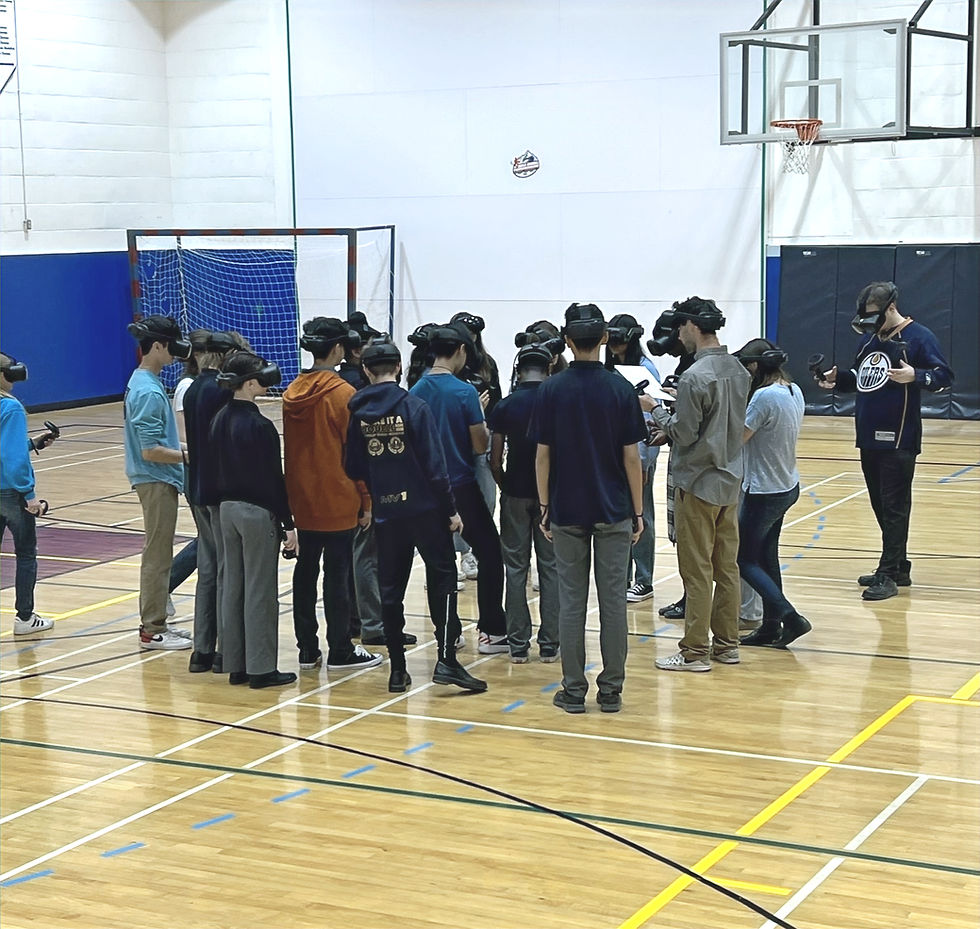
Become one of our pilot schools. Lessons typically goes for 90 minutes, set up is 1 hour prior. Host up to 30 students/teachers per lesson.
Choose Any Lesson.
Pilot Pricing - Pricing below is total students per day


